How to Make Exam Prep Videos That Work
By Ajith Pinninti, founder and CEO of DistilBook · Published September 23, 2026
Ajith builds AI tools for explainer and motion-graphics video: DistilBook, and Framenet AI before it.
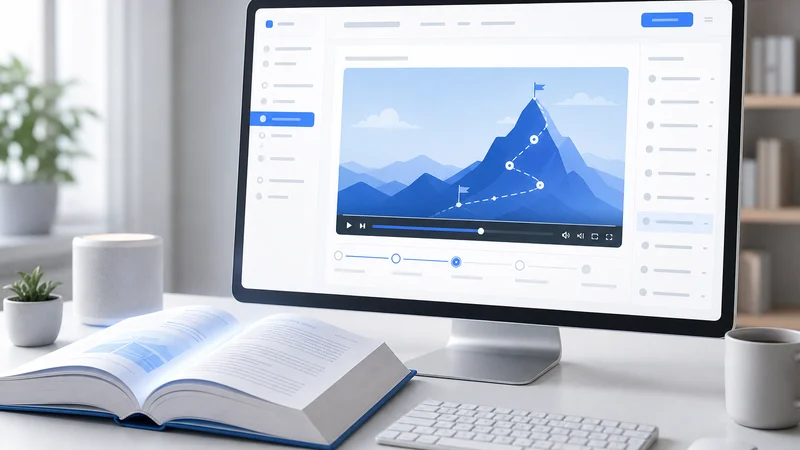
Good exam-prep videos are short, cover one concept each, show the idea as a picture while a voice explains it, and sit between practice questions. Each of those rules comes from research, and each is easy to apply when you turn existing revision notes or question banks into video. Here is the method, with the evidence.
What makes a good exam prep video?
One concept per video, under about 6 minutes, pictures with narration rather than text on screen, and a quick question after each video. Quizzes between segments of a recorded lecture raised final test scores to 90%, against 68% with no quiz (Szpunar, Khan and Schacter, 2013).
Short segments also help: splitting a lesson into learner-paced parts improved learning in 7 of 7 experiments (Mayer, 2023).
Do students actually use video to prepare for exams?
Yes, at scale. Nearly 40% of SAT takers use Official SAT Practice on Khan Academy, and among about 250,000 test takers, 20 hours of practice went with an average 115 point gain (College Board, 2017; Khan Academy, 2020).
Those figures come from the organisations that run the product and show a link, not proof that videos caused the gains. They do show how many students already revise with online video and practice, and 73% of US teens use YouTube every day (Pew Research Center, 2024).
How do I keep exam videos accurate?
Check every number, term and step in the script before the video is made. In DistilBook the narration appears for review before anything is drawn, and it locks when generation starts, so the review is where accuracy is decided.
Exam material punishes small errors. Read the script against the syllabus, fix terms to the exact wording the exam uses, and regenerate a slide's narration with an instruction such as keep the exact formula if the first draft paraphrases it.
How do I turn a question bank or revision guide into videos?
Upload the PDF, choose the pages for one topic, set a short length, pick a whiteboard style, review the narration and generate. Repeat per topic. DistilBook works in 19 languages, so local-language exam material stays in its own language.
Sources
Every number on this page comes from the sources below.
- Szpunar, K. K., Khan, N. Y., and Schacter, D. L. (2013). PNAS 110(16).
- Mayer, R. E. (2023). Research-based principles for designing multimedia instruction.
- College Board (2017). New data links 20 hours of personalized Official SAT Practice on Khan Academy to 115-point average score gains.
- Khan Academy (2020). Studying for the SAT for 20 hours on Khan Academy.
- Pew Research Center (2024). Teens, Social Media and Technology 2024.
Keep reading
How Long Should an Educational Video Be?
The research on educational video length: the 6-minute edX finding, why drawn explanations hold attention longer, why segmenting works, and how quizzes between segments raised test scores from 68% to 90%.
Do Explainer Videos Help Students Learn?
What research says about explainer videos in teaching: video added to teaching (g = 0.80), words plus pictures (d = 1.35), narration over on-screen text, conversational style, and how many teachers already use video.
Best AI Video Generators for Teachers in 2026
AI video tools for teachers, tutors, course creators and exam-prep providers, compared: which turn lesson notes and textbook chapters into narrated lessons, which are free, and which include your logo.