Do Explainer Videos Help Students Learn?
By Ajith Pinninti, founder and CEO of DistilBook · Published September 23, 2026
Ajith builds AI tools for explainer and motion-graphics video: DistilBook, and Framenet AI before it.
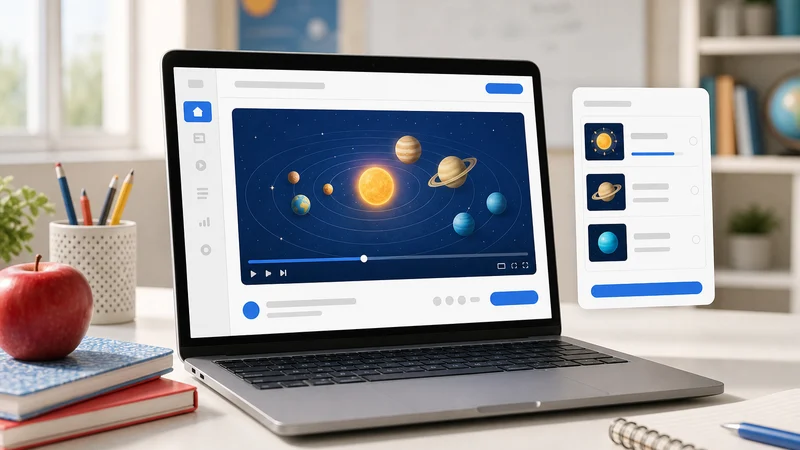
Yes, when video is added to good teaching rather than replacing it, and when it pairs narration with pictures that explain the idea. A 2021 review of 105 randomized trials found strong learning gains from adding video to existing teaching. Below are the eight findings that matter most for a teacher deciding whether to use explainer videos, each with its source.
Does adding video to teaching improve learning?
Yes. Across 105 randomized trials with 7,776 students, adding video to existing teaching produced strong learning gains (g = 0.80), while replacing teaching with video produced small gains (g = 0.28) (Noetel et al., 2021).
The lesson for teachers: use explainer videos alongside your teaching, for pre-reading, revision or students who missed a class, not as a substitute for it.
Why do pictures plus narration work better than text?
In 13 experiments, learners given words plus graphics outperformed learners given words alone on transfer tests, with a median effect size of d = 1.35 (Mayer, 2023). Spoken narration beat the same words printed on screen in 18 of 19 experiments (d = 1.00).
So the most effective explainer shows a picture of the idea and says the words, rather than putting paragraphs on screen. That is the format DistilBook generates: an illustration for each idea, narrated.
Does the tone of the narration matter?
Yes. A conversational narration style beat a formal one in 13 of 15 experiments (d = 1.00) (Mayer, 2023).
Mayer's review also found a human voice beat a machine voice in 6 of 7 comparisons, while noting that modern text-to-speech is closing that gap. If you use an AI voice, write the script conversationally and review it before generating, which is exactly what DistilBook's narration step is for.
How many teachers already use video in class?
Most. In a 2026 survey of 393 US pre-K to 12 teachers, 76.5% used YouTube to teach, about half of them daily or weekly, and videos took up 17.9% of teaching time (Pritchard, Carpenter and Rosenberg, 2026).
Students are already there too: 90% of US teens use YouTube and 73% use it daily (Pew Research Center, 2024).
Can AI save teachers time on making materials?
Teachers who use AI weekly report saving about 5.9 hours a week, roughly six weeks over a school year, and preparing to teach is the most common use (37%) (Gallup and the Walton Family Foundation, 2025).
Turning an existing lesson PDF into a narrated explainer is one of the clearest cases: the material is already written, and the video is generated from it.
Sources
Every number on this page comes from the sources below.
- Noetel, M., et al. (2021). Video improves learning in higher education: a systematic review. Review of Educational Research 91(2).
- Mayer, R. E. (2023). Research-based principles for designing multimedia instruction. Society for the Teaching of Psychology.
- Pritchard, Carpenter and Rosenberg (2026). Educational Researcher. doi.org/10.3102/0013189X261457604
- Pew Research Center (2024). Teens, Social Media and Technology 2024.
- Gallup and Walton Family Foundation (2025). Teachers and AI survey, 2,232 US teachers.
Keep reading
How Long Should an Educational Video Be?
The research on educational video length: the 6-minute edX finding, why drawn explanations hold attention longer, why segmenting works, and how quizzes between segments raised test scores from 68% to 90%.
Best AI Video Generators for Teachers in 2026
AI video tools for teachers, tutors, course creators and exam-prep providers, compared: which turn lesson notes and textbook chapters into narrated lessons, which are free, and which include your logo.
What Is an Explainer Video?
What an explainer video is, the five main types, what they cost in 2026 from agencies to AI, and the length data that actually predicts completion.